Sunday, October 28, 2012

Movie Monday #16: The Tournament


"Is it my accent or something?"
--Kelly Hu as Lai Lai Zhen, The Tournament

I’m a sucker for an assassin movie due to my formative teenage years being spent watching John Woo’s Hong Kong classics (A Better Tomorrow, The Killer, and Hard Boiled are his three best).  The problem these days is making your average assassin movie interesting enough to pick up off the movie shelf, simply because there are so damn many of them.  I had the pleasure of taking in an assassin film that turned the whole genre into a giant kill-or-be-killed tournament, with plenty of action and thrills to spare.  I’m talking about the Scott Mann film The Tournament.

The story of this film is that every seven years, an unsuspecting town is selected as the battleground for the top thirty assassins in the world.  The challenge is to be the last one standing, winning the large cash prize and the prestige of being the world’s top killer.  The entire contest is viewed through closed-circuit television by a group of mysterious, rich men, who bet on the contestants like a sporting event.  This whole sha-bang is organized by Powers, played to the hilt by Liam Cunningham, a man whose face I’d never seen before but whose voice I’d definitely heard on commercials and from videogame and animation voice-overs.

When the film opens, Joshua Harlowe (Ving Rhames) is participating in the last contest, seven years ago.  He’s out of bullets in his gun, has no other weapons to speak of, and is up against a machine-gun-toting maniac who isn’t taking kindly to Harlowe’s announcement that he’s retiring from the business.  In a bit of trickery, Harlowe pulls off the victory, killing this maniac with some kind of pressurized air gun, blasting his head to pieces.  I should note that this movie is not for the squeamish--there are plenty of body parts and organs flying around and detonating spectacularly.  This may sound like a bad thing, but it really doesn’t detract from the viewing--it adds a dimension of grim reality to the competition that’s about to take place.

Flash-forward seven years, and it’s time for a new tournament.  Enter Lai Lai Zhen (Kelly Hu in a smoking hot role), a Chinese assassin who arrives at her hotel, wakes up the next morning a little groggy from being implanted with a tracking device, and gets a major wake-up call when one of these hitmen attacks her, pretending to be room service.  After some high karate on Lai Lai’s part, she gets her first kill, and she moves up the leader board.

To my surprise, the film proceeds to develop a side story about Father Macavoy (Robert Carlyle), an alcoholic Catholic priest whose faith is a mite weak.  When he enters a diner and has breakfast, one of these ‘contestants’ (the incredible Sebastian Foucan, the inventor of Parcour) enters as well, cuts out his tracking device, and drops it in Father Macavoy’s coffee.  Now, everyone thinks Father Macavoy is that contestant, and this unsuspecting priest has entered the tournament.

Lai Lai Zhen tracks Macavoy down, thinking he’s the Parcour guy, and gets assaulted by a Russian Special Forces maniac who was pulling off incredible martial arts moves without wires.  The only other person I know who has done moves like this without the aid of any apparatus is Matt Mullins (Kamen Rider: Dragon Knight), so this was a welcome surprise.  Lai Lai almost loses this battle, if not for some quick thinking on her part, as she pulls one of the pins on a grenade on the Russian guy’s combat vest (while giving him the finger, no less).

After determining that Father Macavoy is not a willing participant, Lai Lai calls Powers on the emergency line, informing him of this situation.  He sees this as a great betting opportunity for his assembly of mysterious, rich pals and tells her that he’d better start killing, or else he’ll end up dead too...and puts the priest up on the leader board, with the odds of five hundred to one.

Shortly thereafter, Harlowe appears on the grid--seems someone came after him in his Miami home and killed his wife.  He’s come back to the tournament for revenge, because he has information that his wife’s killer is one of the contestants.  So what does he do?  He kills the film’s writer, Nick Rowntree, who cameos for about five or six lines as one of these assassins.  Well, they’re always saying that directors want to kill the writers, so why not do it through the magic of film?

As Harlowe keeps gathering information through each person he kills, Lai Lai and Father Macavoy are in survival mode--she’s trying to keep him alive while avoiding his constant question of “Why are you here?”  When they finally acquire a car, Lai Lai drives as far as she can out of the city, so the tracker won’t be as effective.  Meanwhile, Harlowe has acquired a tanker truck and is following Lai Lai’s tracker.  Everything is set for the final showdown, and what a showdown it is.

It’s pretty clear at this point that I can’t say enough about this movie, because it reminds me of classic 1980’s action films, but done one notch better.  Kelly Hu, as previously mentioned, is absolutely gorgeous (as always) and is smoking hot whether she’s beating the crap out of someone with martial arts or blasting someone with a gun in each hand (which was probably paying homage to John Woo in some way).  Robert Carlyle is perfectly cast as Father Macavoy, a man who has lost his church, his congregation, and his will to live, and finds it all again through the help of Lai Lai.

The only part I didn’t really understand was Ving Rhames as Harlowe.  Rhames plays this part like he’s a guest star in a TV movie, and his part is written in that fashion, even though he should have been the main character.  He seemed distant and out-of-place throughout the entire film, and his talents seem wasted on such a small part as this.

Despite this semi-major flaw in the film, everyone else is also perfectly cast--the hitmen look and sound like hitmen, the bystanders look and sound like bystanders, and the hilarious tech guys who run the closed-circuit cameras sound like total neurotic geeks who should spend more time outside.

The action in this movie is incredible--lots of gunfights, lots of chases, lots of martial arts--and none of it seems forced or just for the sake of having it.  Once you have established the parameters of the world this movie operates in (sort-of a “Pay-Per-View” tournament/sporting event thing), everything else falls into place, and that was a very nice thing to see.

Style-wise, the movie is shot in very drab surroundings with very dark, drab colors, adding to the dark, internal struggles of the three main characters...and let’s just face it, folks--assassins killing each other in a competition every seven years for a cash prize is a pretty dark thing.

The Tournament is a film that delivers on all fronts--action, plot, and characters.  It lays down some commentary about how the world sensationalizes sporting events, and that maybe something like this assassin tourney is where we’re heading.  Luckily, it doesn’t get too bogged down in that and never forgets what it is--a damn good action movie.  If you’re looking for a great action-thriller to add to your collection, then look no further than The Tournament.

Monday, September 3, 2012

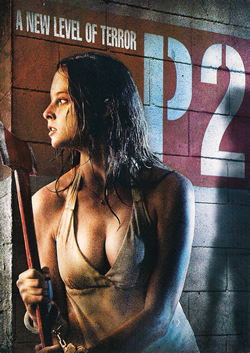
Movie Monday #15: P2


I was perusing the shelves of my local Blockbuster Video store (which, sadly, has been closed due to the rise of Redbox and Video on Demand) back in May and spotted the movie on their previously viewed shelf that you're reading about right now--P2, a low-budget horror vehicle featuring a girl trapped in a parking garage with a sadistic security guard on Christmas Eve.

With Halloween two months away, I thought now would be the perfect time to review P2 and let you know that it's one of the few horror movies I actually like.

###

 “I know you're just trying to humanize me, Angela, so stop it!  Stop it!"
--Wes Bentley as Thomas, P2

In case you couldn't tell by reading this blog, I'm not a big fan of horror movies.  I think it stems from a childhood fear of Chucky, the sadistic doll from the Child's Play films, and the fact that I have no tolerance for pointless gore.  I do, however, find myself watching a few horror films a year and enjoying them on varying levels.  But there is one that stood out to me above all the others as one of the best experiences I ever had watching a horror flick, and that movie is P2.

P2 (named after the parking garage level it takes place in) starts off simple: Angela (played by Rachel Nichols), a corporate workaholic who is staying late at the office on Christmas Eve, finds that her car is the only one left in the parking garage...and that it won't start.  When Thomas, the overly-friendly security guy (played by Wes Bentley), gives her a jump, the car still doesn't work.  He offers to give her a lift, and even invites her to share Christmas dinner with him in his office, but Angela turns him down and calls a cab.

Unfortunately, Mister Security Guy has locked all the doors in the building, so Angela can't get out to the cab in time before it pulls away.  When she storms down to the garage to have a word with the guy, he turns the lights out on her and forces her into his office...where he drugs her, puts her in a white gown, and forces her to have Christmas dinner with him while she's cuffed to a chair.  Angela, however, is no dummy, and soon devises a way to escape Thomas's clutches (by stabbing him with her dinner fork) and call for help.

But alas, there is no help coming.  This is Christmas Eve, remember?  Angela has to fight her way out, using whatever tools are available, including a fire axe, a crowbar, and Thomas's stun gun, to name a few.  Thomas has a few tools on his side as well, such as filling the garage's elevator with water, using all the security cameras to track Angela down, and unleashing a very nasty Rottweiler that he's named Elvis.  And just when it seems Angela's figured out a way to beat Thomas and escape, Thomas figures out a way to stop her, which leads to a game of chicken in rental cars that will make your jaw drop.

You can say all you want about P2 being one of those low-budget, one-location horror films--it makes great use of its location (the parking garage) and the little nooks and crannies that occupy it.  I've never felt very safe in a parking garage, and after watching P2, I think I know why--they're very creepy when they're empty and dark!  This film plays on that perception and heightens it to the umpteenth level, creating the ultimate "what if" scenario.  The idea is ingenious and it hasn't been done before, so hats off to the creative team for their effort in that department.

The casting for the film couldn't have been better.  Rachel Nichols was perfect for Angela, because she could play both sides of the character--the desperate, frightened corporate employee who just wants a way out...and the kick-ass heroine she becomes when she's finally had enough.  She spends most of this film barefoot and in a cleavage-bearing white dress, which is a real challenge for any actress to take on, and Rachel pulls it off with sympathy and credibility. 

Wes Bentley is the perfect villain as Thomas, a guy who could be the creepy security guard in real life, let alone in P2.  He pretends to be gentle and caring to Angela in the beginning, but once she starts to rebel against his wishes, his psycho side starts coming out, and that's when you're in for a real treat.  Wes also gives us a taste of his funny side as he performs a homage to the Elvis Presley hit "Blue Christmas" while Angela is knocking out his security cameras with the fire axe.

Oleg Savytski performed the production design on this film, and I've become an instant fan of his work.  From the darkened corridors of the parking garage to Thomas's cluttered office and the elevator that Angela nearly drowns in, the design team made a one-location movie seem bigger than it was and made it last longer than the usual ninety-minute runtime.  They didn't do it alone, though--costume designer Ruth Secord came up with the fifteen different dresses that Rachel Nichols wore during shooting; director of photography Maxime Alexandre gave everything the necessary spookiness; and the music by Tomandandy (a composing team I'd never heard of before) blended perfectly into the background and made us feel exactly what we needed to feel at the moments we needed to feel it.

There are some glaring mistakes in P2, though.  One of them has to do with the scene where Thomas floods the garage's elevator with water and Angela presses the up button.  The elevator moves up and takes the water with it.  It looks downright silly, and according to IMDB, elevators are designed to drain the water out through the bottom if such an event occurs.  Two of the smaller mistakes involve the fork that Angela stabs Thomas with (it never stays in the same position) and a scene where a crew member's silhouette is visible on the wall of the rental car area.

One of the other issues with P2 is that it has the dreaded "3 Screenwriter Curse," meaning that three separate writers worked on the script.  In Hollywood, one screenwriter can either be good or bad; two screenwriters (or a two-person writing team) is usually a good bet; but three screenwriters is a recipe for disaster.  Jumper is a good example of this, since it had three screenwriters and was one of the worst movies I saw that year.  A more recent example would be the Sam Worthington vehicle Man on a Ledge, which not only had three screenwriters but was also a one-location film (and played out more like a TV movie than anything else).

Do you get what I mean by the 3 Screenwriter Curse?  Good, because I'm here to tell you that P2 rises above the curse and delivers on all fronts.  The script by Franck Khalfoun (who also directed the film), Alexandre Aja (who produced the film), and Gregory Levasseur (who also produced the film) gave us the perfect setup, the perfect amount of dialogue, and the perfect moments of tension to deliver one of my favorite horror films of all time.  I tend to gravitate toward unique, independent productions, and with P2 being an eight million-dollar parking garage film, I knew I had to see it.  I was not disappointed, and you won't be either...though you might become a little leery of being the only car in the parking garage at night.

Sunday, February 26, 2012

Movie Monday #14: Sleuth

Most of you who read this blog have gotten to know my viewing habits fairly well.  I tend to like pretty much whatever I watch, since I don't go out of my way to watch movies I'll hate.  But recently I came across a movie that made me squirm in my seat, and it wasn't from horrific special effects, either.  It was the 2007 remake of Sleuth, starring Jude Law and Michael Caine.  I picked it up for $2.50 and, as you'll find out, that's about all it was worth.

###

"Do you fancy me?"

Jude Law as Milo Tindle, Sleuth

I just came up with a new t-shirt slogan that would best describe this blog--“I came.  I saw.  I bought cheap movies.”  I wish I had a shirt like that, because it would describe my experience at the Fairchance Pharmacy in Fairchance, PA, not so far from my hometown of Uniontown, PA, where I spent some time picking up, what else, cheap movies.


The Fairchance Pharmacy actually has a video rental joint inside of it, and they do a good business in new and used merchandise.  I had a ball looking through their used items, and picked up four movies that day, all of which will be the subject of later reviews.  One of these films, Sleuth, caught my eye because it only had two actors in the entire film--Michael Caine and Jude Law.  Let’s dive in and see what they have to offer us.


The movie opens with a montage of surveillance camera footage as a car pulls up to a recently remodeled English manor.  Andrew Wyke (Caine) is the owner of this manor; he’s a world-famous crime writer who recently separated from his wife.  Milo Tindle (Law) is his recently-arrived guest, and the man currently sleeping with Andrew’s wife.  At first, I wasn’t sure what to make of this film, because it’s basically about nothing for a good ten minutes...until Andrew brings up the subject of his wife, and how Milo has come to discuss a divorce settlement with him.


But instead of a divorce settlement, Andrew comes up with this grand scheme to have Milo “rob” him of precious jewels that are in his bedroom safe.  After almost flubbing this, Milo realizes that Andrew isn’t playing a game anymore -- he’s not going to give his wife a divorce, and the gun he’s pointing at Milo has a live round in it, ready to end his life.  And just when Andrew pulls the trigger--


We cut away to a car speeding toward the manor.  This is Inspector Black of New Scotland Yard, asking Andrew about the murder of Milo Tindle.  Andrew becomes uncomfortable as this inspector starts to gain the upper hand on him--until it’s revealed that Inspector Black and Milo Tindle are the same person.  Now that that’s settled, the movie moves into its third act, much like the play it was based on, to which I can only say this: it was wicked and rather unsettling.


In fact, this whole movie is unsettling.  There’s something vaguely homosexual going on between Andrew and Milo, and it only intensifies in the third act.  Maybe I’m not as open-minded as I should be, but I don’t agree with that lifestyle, and I sure didn’t want to see Jude Law kiss Michael Caine, even if it was slightly off-camera.  Aside from their vague homosexuality, Caine and Law deliver dynamite performances that draw you in and never let you go.  That’s the problem with Sleuth--you know you shouldn’t be watching a movie this bad, but you can’t stop watching it because the actors in it are doing a damn good job at keeping this sinking ship alive.  


The direction by Kenneth Branagh, a director that is described on the back of the DVD case as “critically-acclaimed,” was nothing but static shots accented with blue and purple lighting inside Andrew’s manor.  One shot that stood out to me as being particularly horrible was one spying on the two characters through window blinds.  I couldn’t make out what was going on, and this shot just held and held and held on those freaking blinds.
 

This is another quibble I have with independent film, especially British “indie” film--some of these movies aren’t about anything worth watching, and this was one of those.  Aside from the stellar acting, poor direction, and the almost non-existent music, the only redeeming quality this film had was the production design, which was by a chap named Tim Harvey.  His design for the remodeled manor was superb, even including a little two-person elevator that rose to Andrew’s bedroom on the second floor.  The lighting by Haris Zambarloukos was also noteworthy.
 

Unfortunately, lighting and production design do not a movie make, and even when you’ve got star power like Michael Caine and Jude Law, two fine actors in their own rights, the boat is going to sink when the captain relies on the ping-pong close-up to get his point across.  The static, almost clinical way that Kenneth Branagh directed this film just killed any potential it had at being a good movie.
 

So do yourself a favor--even if you see this one in the bargain bin at two dollars and fifty cents, which was where I found it, let this review be your guide and just stay away from this stinker.  Or, if you actually like bad movies, you can do what my friend Mindy does and make a “Bad Movie Night” out of it with your spouse, boyfriend, girlfriend, or just a friend or two.  

Anything’s better than taking this movie seriously, because it doesn’t even deserve that.

Wednesday, December 21, 2011

Movie Monday #13 -- Breakaway

I know this is a really late update, but I thought I'd get a review in before the year was up.  *sigh*  Time has escaped my grasp once again and prevented me from updating on a regular basis like I would have wanted to.  Anyway, here's a review of the 2002 film, Breakaway.

###

“What’s the matter, slick? You out of ammo?”


--Dean Cain as Cornelius Morgan, Breakaway

As far as Christmas action movies go, there are very few that exist. John Frankenheimer’s Reindeer Games comes to mind as one of them, but most people would like to forget that one was ever made. I’d like to review one here that is simply good entertainment--the 2002 made-for-TV movie Breakaway, starring Dean Cain, Erika Eleniak, and one of my favorite villains of all time, Eric Roberts.

The movie opens with the dramatic music of John Debney (more on that in a minute) and shows various angles of shoppers inside Chicago’s busiest mall, Chicago Place. With Roberts’ narration running over this, he explains to his crew of thieves that on Christmas Eve, there will be twelve million dollars in untraceable cash in Chicago Place’s basement vault...and they’re going to take it.

Enter Cornelius Morgan (Dean Cain), a lieutenant on the Chicago P.D. who can’t afford to give his wife Cat (Erika Eleniak) what she wanted for Christmas. His attention is soon diverted to the Lotus Flower Society in Chinatown, where a group of Triad gangsters attempt to rob the club. In the ensuing shootout, Morgan accidentally wings the head of the Lotus Flower Society, who is sort-of like the Mayor of Chinatown, and this pompous ass decides to sue the city of Chicago for forty million dollars in damages...and personally lists Morgan as a co-defendant.

With all this hanging over their heads, Morgan and Cat attend a children’s Christmas concert, which features both Morgan’s daughter and Jimmy Scalzetti’s (Eric Roberts) son. In a brief scene after the performance, Morgan sees Scalzetti speaking to his wife about his son Anthony, who has leukemia and needs a bone marrow transplant. The operation will cost in the upwards of millions of dollars (since ex-cons can’t get insurance, something I had never thought of), which explains why Scalzetti and his crew are taking down Chicago Place.

Unfortunately, Cat works at a jewelry store at said mall, and is staying late with an indecisive customer on Christmas Eve. Morgan, feeling that a recent fight with Cat needs to be settled before the sun goes down, buys her flowers five minutes before the mall closes...and spots Jimmy Scalzetti’s crew stepping through a security door. With only a few moments to make a decision, Morgan decides to tail them back into the labyrinth behind the mall and just misses them taking a service elevator to the basement.

Morgan’s response to all this is a hearty “Retired my ass...” as he prepares himself for what is the craziest, most action-packed TV movie I have ever seen. Breakaway has things that just aren’t done on a TV movie budget, and I really wish there was some kind-of behind the scenes material available for this, because it would explain how they did the stunts and gunfire and explosions on such a limited budget and without too many stuntmen.

In the gun battle between Morgan and Petreovich, a taller-than-tall Russian thug with some kind of combat shotgun for a weapon, Morgan is running behind payphone bays (which are exploding brilliantly), the railing of the mall’s upper floor (which is sparking brightly), and a snowman statue (which detonates into shards of confetti and cardboard that always make me proclaim “Blow up the snowman, blow up the snowman!”). All of this is filmed in John Woo-like slow motion, adding to the agonizing brutality of what Morgan is enduring not only during this gunfight, but throughout the entire film.

My dad, after watching this movie, described it as “Die Hard in a shopping mall,” and that’s exactly what it is, because Morgan has to use all of his wits and anything available to him in order to take down Scalzetti’s crew and Scalzetti himself. One of the more interesting things this film brought to light was pioneering the use of shampoo as a deterrent to your foes. This may sound hilarious to you, but when Morgan is facing Simulus in the upscale department store, he spreads shampoo near an escalator exit. When Simulus comes running up with guns blazing, he goes sliding through several displays and ends up shooting the head of a mannequin (another moment that made me happy; mannequins freak me out).

There are also several twists and turns in this movie that surprised me and raise it one notch above your average action film. One thug that the movie leads you to believe is dead actually comes back to attack Morgan a second time; apparently his injury was not that serious. Additionally, Scalzetti takes some hostages, including Morgan’s wife Cat, which can only ramp up the tension about ten thousand notches for our hero.

As for the acting, it’s about what you’d expect from a TV action movie, but the absolute stand-out roles here are Erika Eleniak as Cat Morgan and Eric Roberts as Jimmy Scalzetti. For Erika, here was a role that was not asking her to be half-naked all the time or to show her breasts (can we say Under Siege, anyone?). She really got to show that she can act and make it be believable, and make herself be sympathetic to the audience. Hats off to Erika for a job well done.

As for Eric Roberts, the casting couldn’t have been better. He pulls off Jimmy Scalzetti with the right amounts of wit, sarcasm, and cold-blooded criminal that I have come to expect from this very talented actor. And while I have previously complained that he tends to play very one-dimensional villains, here was a villain that was two-dimensional--he wasn’t taking down Chicago Place without a reason (he needs the money for his son’s bone marrow transplant, remember?), and it wasn’t like he hadn’t tried other avenues (ex-cons can’t get insurance, remember?). This character was a desperate man with desperate means to take down an impossible score...and whether he makes it or not is up to you to find out.

The music was composed by two different musicians--the main theme was done by John Debney, which is a name I remember from other TV projects and action films. The rest of the music was done by Louis Febre, who did an awesome job accenting the adrenaline-pumping action scenes in this film.

There is one quibble I had with Breakaway, and it’s that the film suffers from “one-liner” syndrome. This happens with two of the lines that are repeated at least three times by different characters throughout the film. In the first instance, Morgan says to one of the Triad gangsters, “Now there’s an easy way and there’s a hard way. Do the right thing.” His own partner, Rich, says it the second time. The third time comes once again from Morgan when he has Scalzetti in his sights near the end of the film. Now do you see what I mean by “one-liner syndrome?” This is something that, oftentimes, first-time writers and directors suffer from, because they think they’re being cool. To me, it just comes off as bad writing.

The other instance of “one-liner syndrome” came with the line, “You’re a class act, (insert character name here).” I caught that three times as well--first with Morgan, then with Rich, then with Scalzetti. This sort-of thing happened a lot in 80’s action movies too, of which I am a fan, but merely for the stunts and production design--not for the cheesy dialogue. Something tells me this might have been an older script that was hastily updated when it was called into production, and they overlooked the “one-liner syndrome” that often plagued its 80’s cohorts.

If you’re able to put this aside, you’ll find a very decent Christmas action movie that doesn’t scrimp on the effects and the stunts just because it’s a TV movie. If you’re a fan of Dean Cain, you won’t be disappointed either, because he pulls of a very strong performance in this film as the cop that just won’t quit. And if you’re a guy looking for some testosterone-fixin’ this holiday season, and you stumble on Breakaway, then lucky you--you’re in for a holly-jolly good time.

Sunday, August 14, 2011

Movie Monday #12 -- Risk

“Let me put this in words you can understand--fuck off!”

Bryan Brown as Kreisky, Risk

I am a huge fan of Australian film. The entire industry seems to have crumbled over there lately, which is a huge disappointment, but when I saw Risk peeking out from behind another DVD in the bargain rack at my local grocery store and spotted Bryan Brown’s picture on the front, I figured I’d at least give it a look. When I discovered that it was an Australian film, I bought it without another thought, and that was an easy thing to do because of its low $3.99 price.

Risk starts off slow, centering on the first day of Ben Madigan’s new job as an insurance adjuster. He thinks he’ll be helping people by granting them money they deserve. What he learns is that the insurance company is only out to protect its money and its own interests; the rookies are taught to pay out the minimum amount of money and use any excuse they can to knock the total down as far as it will go.

Ben is really too innocent for this kind of job, but he does have a knack for convincing people that taking the insurance money is the right thing to do--a skill he learns when senior adjuster John Kreisky takes him under his wing in a little “experiment.” Kreisky proposes that Ben will close disputed claims at an eighty percent payout, thereby leaving the company twenty percent and still making them money.

Ben eventually learns that he’s very good at this, but that Kreisky has covered his tracks with this experiment by initiating a scam to rip off the insurance company. While Ben proposes that he isn’t “doing anything wrong,” Kreisky and his lover Louise work out a deal that involves fake insurance claims posing as real ones, and all three of them get paid nicely for it.

Unfortunately, Ben starts to catch wind of an internal investigation in the company about someone absconding with company funds. When the Australian police come in and launch a full-scale investigation, Ben realizes that it’s high time he developed an exit strategy--and what a doozy it is.

Risk showcases the talents of its three main actors to the hilt. Tom Long is perfectly cast as Ben, the innocent adjuster who gets in over his head in this scam and can’t find a way out. Bryan Brown is the perfect manipulator as Kreisky, always steering Ben back on the path he wants Ben to travel on, not the path that Ben knows he should be on. Claudia Karvan is beautiful, sassy, serious, and downright one of the sexiest Australian actresses put to film as Louise, the woman who is seeing both Ben and Kreisky and is headed to Heartbreak City by the end of the film.

The production design by Murray Picknett was the standout element in this film. Everyone is dressed in warm, dark colors, and so are their surroundings. Even the cars are in coordinating colors, so they don’t clash with the amazing wardrobe by Margot Wilson. I have never been very impressed with the “stylized reality” that some films go for, but Risk pulls this off flawlessly and with seemingly no effort.

The music by Don Miller-Robinson reflected the source music used in the film, something that is becoming rare these days. The musical score included a synthesized Hammond organ, which is a sound I just love from the days of 3 Dog Night, and it worked great in this film to compliment the on-screen events and the other songs used to emphasize various key points.

The lighting by Simon Duggan was not fancy or heavily stylized--it was efficient and to the point, illuminating when it had to, and leaving things dark and mysterious when they needed to be. When you’re trying to accomplish “stylized reality,” sometimes the lighting can be too stylized or too real, but Simon got the balance just right for Risk. Hats off to you, mate.

The script by John Armstrong was tight, poignant, and nerve-racking at the tension-grinding moments. There was a strange lack of humor in this film, with the exception of two or three deliberate jokes, which come off as a little out-of-place but nevertheless funny. Other than that little quibble, I have very few complaints about the writing of the film--it was totally spot-on.

The direction by Alan White (a name I’ve heard before from somewhere) was terrific, never calling for any “independent movie-maker shake” shots (i.e. Paul Greengrass’s hand-held gunfight mayhem in the Bourne films). The shots were steady, the camera moved only to emphasize or stylishly capture a certain tense moment, and never lost its sense of pace. This guy knew what he was doing, and it shows.

Overall, Risk is a terrific thriller that ends on a chilling note (I won’t spoil it for you, though). If you’re up for a film that will entertain as well as make you think about the insurance industry in general, then you’re ready to take in the Australian gem Risk.

Sunday, August 7, 2011

Movie Monday #11: Give 'Em Hell Malone

Last Friday I stopped by Blockbuster Video at Windsor Commons in Red Lion, PA, looking for something different to add to my movie collection.  I found Give 'Em Hell Malone, an action film by Russell Mulcahy (of Highlander fame) that I enjoyed immensly.  I payed $9.99 for a previously viewed copy that didn't have a single scratch, fingerprint, or mark on it, so I had to ask myself--was the movie so bad that nobody was watching it?  Let's find out!

###


“In my world, you have to knife before you’re punched and shoot before you’re knifed, because there’s one golden rule that can never be broken -- once you’re dead, you stay that way.”


--Thomas Jane as Malone, Give ‘Em Hell Malone

Along with all the other things I love about movies, I love it when a movie pays homage to film noir and gangster-era themes. My favorite movie of all time, L.A. Confidential, pays homage to hardboiled detectives and crime novels of the 1940’s and 1950’s, which are quickly becoming the only books I read.

So when a movie comes along that pays homage to film noir, hardboiled crime fiction, and yet creates something new entirely, what do you expect me to do? Sit on my hands and let it slip under the radar? To be truthful, I almost did, if it weren’t for a recent trip to Blockbuster Video at Windsor Commons in Red Lion, PA, where I found Give ‘Em Hell Malone, previously viewed, for ten bucks.

The film opens with a massive, visceral shootout between Malone and at least twelve guys in an empty hotel. Malone (Thomas Jane) narrates over this with wry, period-appropriate dialogue, informing us of his personal opinion of getting shot at, bullets (and their many uses), thugs, and some vital personal information.

Malone has been hired to retrieve a case from the safe in the hotel. After getting shot, having the case stolen from him by a thug named Pencil Stache, chasing this guy down in his resto-rod, shooting out his tires with a shotgun, and letting Pencil’s van smash through several parked cars, Malone visits his mother, Gloria, at the retirement home.

Apparently Malone only visits her when he’s been shot, stabbed, or is in desperate need of medical attention. Gloria doesn’t use anesthesia, so Malone’s screaming can be heard inside (and outside) the nursing home. After getting fixed up, Malone opens the case and finds a blue toy elephant inside.

Returning to his handler’s home with an empty case, Malone wants to know who his client was. Enter Evelyn (Elsa Pataky), a femme fatale in a red coat who claims she must trade the case and its contents for her brother, Sam, or he will die.

And to top everything off, we have Boulder (Ving Rhames), a tough-as-nails hood working for Whitmore (Gregory Harrison), the crime boss of this city. Boulder needs Whitmore’s money to keep his wife’s life-sustaining equipment running, so Boulder goes to track down Malone and get the case back, with a little help from the psychopathic pyromaniac Matchstick (Doug Hutchison).

Along the way, Matchstick sets things on fire, Malone’s mom gets drunk, Evelyn seduces Malone, and Malone runs out of bullets (a rare thing for an action movie). There’s plenty of humor, plenty of action, plenty of surprises, and plenty of nods to the hardboiled heroes of yesteryear to keep any movie fan pleased.

Thomas Jane was born to play Malone. The cadence in his voice, his swagger, the way he uses that huge revolver--everything about Malone--seems effortless for Jane. He makes these kinds of parts look easy. He also makes you cheer for Malone, laugh with Malone, and feel sorry for Malone, sometimes all at once. If there were ever a guy to recreate Philip Marlowe and Sam Spade, it would be Thomas Jane.

Elsa Pataky is smoking hot as Evelyn, the woman who twists Malone from love to hate and back again. The shower scene in the motel room (where Malone can see half of her taking a shower in the bathroom mirror) stood out to me as being very Raymond Chandler and Donald Westlake, and her whole attitude and demeanor were dead on the money for a film with hardboiled themes. Any actress can be easy on the eyes, but it helps if you’ve got the talent to back it up. Pataky is the full package.

Ving Rhames showed flashes of his brief but memorable turn as Kojak in this film. Boulder is a man who used to work with Malone, but turned to a life of crime in order to keep his dying wife alive. Repeating throughout the movie “She’s gonna pull through” to almost every character, Rhames shows that this is a guy who doesn’t really believe in what he’s doing anymore. Does he make the right choice come the end of the film? I’ll leave that for you to decide, but you’re in for a treat with Rhames’s deadpan humor and gangster swagger whenever he steps on screen.

Writer Mark Hosack scribed a terrific script that hits all the action-lover and noir-lover notes just right. Director Russell Mulcahy (of Highlander and Resident Evil fame) put his years of experience to good use in Give ‘Em Hell Malone, pulling off some great stunts, lighting, sets, and special effects on a low budget. Cinematographer Jonathan Hall did a terrific job as well, getting all the film noir trademarks in there--silhouettes, slat lighting, and shadows.

The music, however, is the real treat in this film. The musical score by David Williams features a slow, saxophone love theme that evokes shades of the opening credit music to Basic Instinct and Body Heat, but he didn’t stop there. He added synthesizers, mini-moogs, and crazy drum beats to the action and chase scenes to show the modern side of the production, while keeping the old film noir sound. I’ve never heard music done like that before, and Williams is now my favorite movie composer because of it. Watch out for this guy, folks--he’s going to go places.

So, with all of this going right for Give ‘Em Hell, Malone, what could possibly be wrong with it? Not much, but I did find it a little confusing near the end of what screenwriters call Act Two (the middle section of the film), because there were one or two twists that twisted a bit too fast. You also have to take into account that this is a Russell Mulcahy film, and that means logic can sometimes go out the window.

Other than those two quibbles, I enjoyed Give ‘Em Hell Malone a ton. It had laughs, action, and suspense, and the whole homage to the hardboiled era only enhanced the fun factor for me. This was worth every penny of the ten dollars I spent on it, and I’m looking into some of the other titles that its distributor, National Entertainment Media, has available. I wish they made more movies like this and in this style, but for now, I will sit back and watch Give ‘Em Hell Malone till they discover a way to bring Chandler and Westlake back to life...and that could be a while.

Monday, August 1, 2011

Movie Monday #10: Night Train

Last Friday I spent some time looking through the bins at Tom's Music Trade for some cheap movies to add to my collection.  One of the movies I ran across was Night Train, M. Brian King's 2008 noir mystery vehicle, which I snagged for $1.99.  The original Blockbuster Video price tag was still on the case, which listed the price as $14.99.  Sure, I got the movie for a song...but was it worth it?

###

“Who hasn’t chopped up a corpse from time to time?”

--Steve Zahn as Pete, Night Train

The concept of a movie on a train has been done to death.

There. I said it. I got it off my chest.

But there hasn’t been a movie on a train in a long time, and the genre seems to have disappeared altogether from Hollywood. So when an independent thriller comes along that takes place on a train traveling to nowhere on Christmas Eve, I was intrigued...and now that I’ve seen Night Train, I can say that the genre hasn’t been done like this in a long time.

Miles (Danny Glover) is a veteran train conductor who merely wants to get home to his ailing wife by Christmas morning. At the first stop for his train, a strange man comes on board carrying a Christmas present. He takes a seat in the rear car, where washed-up salesman Pete (Steve Zahn) and pre-med student Chloe (Leelee Sobieski) are trying not to be weirded out by the new guy.

As the train gets under way, Miles stops by the rear car to see the stranger again. It seems the guy didn’t pay for a ticket, but that’s not going to be a problem--he’s dead. As Miles, Pete, and Chloe investigate this incident, Pete opens the Christmas present and finds a small, wooden box inside...and inside the box are five million dollars worth of white diamonds.

Miles thinks they should report the dead man to the authorities. Pete thinks they shouldn’t. Chloe points out that they can dump the stranger’s body from the train and into an upcoming river without anyone being the wiser...and soon, everything starts to snowball out of control as Chloe gets more and more manipulative, Miles starts to regret that he ever found the box, and Pete is too scared to think straight, which all leads to a smashing climax aboard the runaway train.

Danny Glover is someone who, after Lethal Weapon was said and done with, has really supported the independent film community with his work. He gives a performance here that’s as solid as I’ve ever seen from him. Everything about the character of Miles--his gait, his limp, his voice, and the way greed twists at his heart--really made me admire Glover as a terrific actor, and not just a straight man to Mel Gibson.

Leelee Sobieski is something of an enigma to me. I’d only seen her in Joyride before this, and while I thought she was gorgeous and definitely had talent, I didn’t know what else she brought to the table. Miss Sobieski proves that she has the acting chops to compete with some of the best out there in Night Train. Her turn as the manipulative and slightly psychotic Chloe is one of the better and more realistic femme fatale portrayals I’ve seen in recent years, and the more horror-oriented elements of the film played to her strengths quite well. I’ll be looking for more of her work from now on.

Steve Zahn (who co-starred with Sobieski in Joyride) has been redefining himself lately as someone who can take on dramatic roles (see his turn in A Perfect Getaway for evidence of this) as well as comedic ones. His character, Pete, slowly develops over the period of the film into the audience’s guilty conscience, since he’s the one who wants to run away with the box and never come back, and ends up getting killed by his own greed. A good lesson to be learned by anyone who wants to pursue a life of crime, and a lesson well-acted by Steve Zahn.

Writer/director M. Brian King confesses a childhood love for trains in an interview on the DVD, and it shows in every frame of Night Train. The entire movie takes place on the train (say for the last few minutes), and while the exterior train shots were all done with CGI, that didn’t seem to bother me very much--King clearly knew how he wanted his film to look, to sound, and to feel, and he brought every bit of that to the table.

Production Designer John Welbanks is the kind of guy I’d hire if I were making a movie. He had to design a wooden six-car train setup inside a studio in Yugoslavia and get it done on a budget. The results speak for themselves. The train itself looks like an old model that’s ready for retirement. The interior has a 40’s-style wood finish. There are Christmas decorations and twinkle lights everywhere. And the best part of it all was the baggage cart, a cold, wrought-iron place where Chloe “improvises” with how to dispose of the dead stranger. Kudos to John for creating a gorgeous and believable backdrop for the film to take place in.

My only real complaint about the film was the lighting by Christopher Popp. I don’t know if it was a style choice or if it was M. Brian King’s choice, but for the majority of the movie, everything is fully lit, all the time. I realize it takes place on a train, and that trains are fully lit the majority of the time, but a little mood lighting wouldn’t have hurt in certain spots. The only real lighting change was in the baggage cart scenes with the florescent bulbs, which was absolutely gorgeous, but the soft, happy lighting downplayed the dark, noir-like themes going on on-screen. Somebody needed to do their homework on what noir lighting is all about, but as to whose flub it was will remain a mystery.

If you watch Night Train, be prepared for a Hitchcock-like noir thriller that takes an unexpected sci-fi twist, and get ready for lots of other twists along the way too. While it’s not the best film I’ve ever seen, it certainly grabbed my attention with the mystery of the dead man and his mysterious box, and the things the characters do for the box’s contents are believable and keep your interest. If you like your movies a little on the darker side and with a touch of the macabre, then you’ll love Night Train.